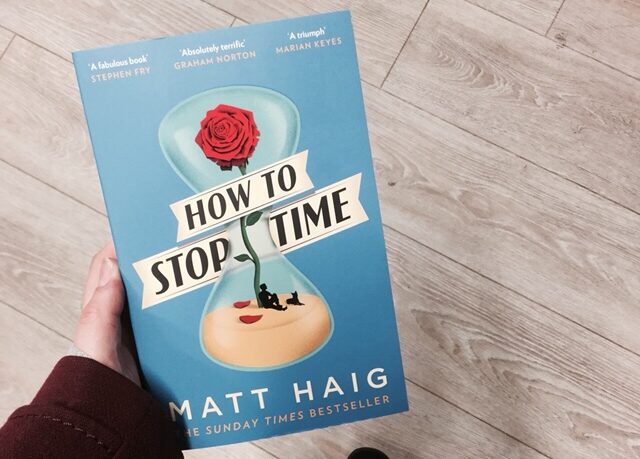
Author: Matt Haig
Genre: Science Fiction, Historical Fiction, Fantasy, Romance
Number of Pages: 374
Published: June 6, 2017
Matt Haig’s books don’t put pressure on the reader. They are deep yet accessible, which I truly appreciate. I love when complex ideas are expressed in a way that anyone can understand, and Haig is one of the few contemporary writers I enjoy reading.
My first experience with his work was The Midnight Library, a book that moved me deeply. After reading it, I decided to pick up How to Stop Time to see what emotions it would evoke.
Plot
Tom Hazard returns to London after centuries of wandering. Born on March 3, 1581, he has barely aged since. When he first realized something was wrong with him, he visited a famous doctor of the time, Dr. Hutchinson. Days later, the doctor was found dead in the Thames. This is when Tom learns he is not alone. A secret society, The Albatross Society, exists to protect people like him—those who do not age.
Through The Albatross Society, Tom meets Hendrick, who teaches him how to assume new identities, travel the world, and recruit others like him. Along the way, Tom encounters historical figures such as Shakespeare, Captain Cook, and F. Scott Fitzgerald.
Returning to London triggers a flashback of memories, including the tragic fate of his mother, who was murdered in the 16th century after being accused of being a witch — only a witch, they believed, could give birth to someone who did not age.
The story also reveals Tom’s greatest love: Rose, whom he met after his mother’s tragic death. They got married and moved frequently, and soon their daughter, Marion, was born. But Rose was aging, and before long, the difference between them became too obvious—Tom could easily be mistaken for her son. When suspicion arose about his unnatural life, Tom was forced to leave them for their own safety.
Full Summary

During his long life, Tom had all sorts of jobs, but he always avoided having his picture taken or getting too close to people to protect himself and the secrets of The Albatross Society. Only once, a famous photographer captured his image at a well-known hotel where he worked as a pianist. Years later, that photo was still there.
As always, he changes his identity and returns to London for another job. This time, he decides to become a history teacher—after all, he has personally experienced everything he will be teaching his students. Over time, the students come to admire him for it.
His colleague, the French teacher Ms. Camille, often looks at him strangely, as if trying to recall where she has seen him before. This raises Tom’s suspicion, and he starts to believe that Camille might be a member of The Albatross Society.
Soon, they become close friends, and Tom reveals his secret to Camille. He also tells her about his daughter, Marion, who inherited his condition. Tom confesses that he has spent years searching for her and never gave up hope. However, he soon realizes that Camille is not like him—she recognized him from that old photo in the hotel. He begins to consider leaving her for her own safety.
Hendrick reaches out to Tom with news about his old friend in Australia, Omai. Tom and Omai met years ago when Omai was Captain Cook’s translator. They were both sailors on that voyage but haven’t seen each other in ages.
Hendrick claims that Omai’s public life threatens to expose The Albatross Society and that Tom must fly to Australia to stop him.
When Tom arrives in Australia, he learns that Omai is tired of hiding and just wants to live his life fully—he believes that the only way to stop time is to embrace the present.
Soon, Tom discovers that Hendrick has been in contact with Marion all along and has convinced her that her father is a threat to society. They finally meet in Australia, and at first, Marion is furious—she even points a gun at Tom, ready for revenge. But Tom explains how desperately he has searched for her.
At that moment, Marion turns the gun on Hendrick instead.
For Tom and Marion, Hendrick represents all the people who made them suffer—the ones who killed Tom’s mother, the ones who hunted and threatened them.
When Marion shoots him, she and Tom return to London. They try to live their lives to the fullest, finally free to be with the people they love.
Tom ends up with Camille. They fly to Paris, where Camille is pregnant, and for the first time, they are no longer worried about the future.
Analysis and Review
It is interesting how Matt Haig always writes about life, and it feels like he wants to teach us to appreciate it. What truly matters is love, and even after 400 years, Tom has never given up hope of finding his daughter. After many years of grief, life gives Tom the opportunity to be happy again.
According to the author, loneliness can sometimes be a choice. All human beings need connection and care. It is better to enjoy the time you have with the people you love rather than isolate yourself from everyone, because the only way to truly live is to accept what life brings you.
The Albatross Society promotes secrecy and survival, but Omai offers a different perspective: to truly live, one must stop fearing time and embrace the present. The novel suggests that fear of the future can prevent us from truly experiencing life.
The Albatross Society symbolizes control through fear. Hendrick dictates how its members should live, showing how institutions can manipulate individuals under the guise of protection.
Haig’s prose is simple yet profound, making complex themes accessible. He doesn’t overcomplicate emotions, which makes Tom’s internal struggles deeply human and relatable. I personally rate the book 8 out of 10.
Books like How to Stop Time
If you enjoyed How to Stop Time summary, you might like these books that explore similar themes of time, memory, love, and the meaning of life:
1. The Midnight Library – Matt Haig
2. The First Fifteen Lives of Harry August – Claire North
3. The Time Traveler’s Wife – Audrey Niffenegger
4. Life After Life – Kate Atkinson