Author: Fyodor Dostoyevski
Genres: Novel
Originally Published: 1869
Number of pages: 932
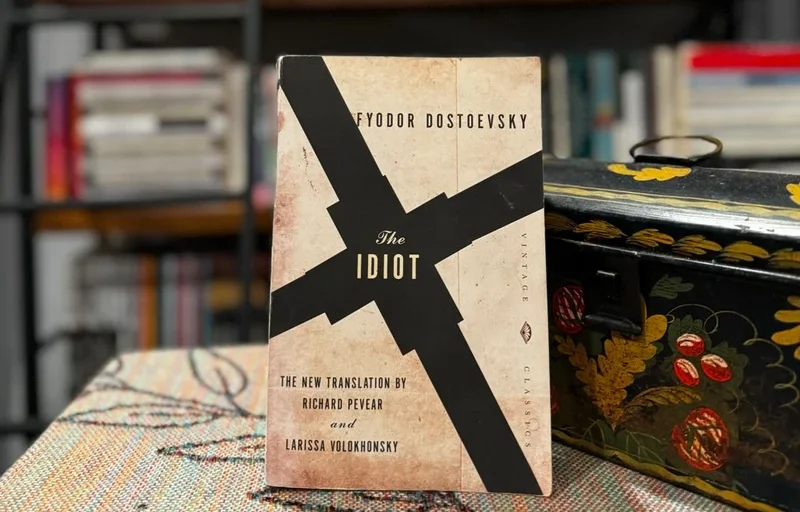
Dostoevsky’s The Idiot is one of my most favorite novels, telling the story of a perfect and innocent man living in our non-perfect and definitely non-innocent society. The book touches on themes such as religion, the purpose of life, and most importantly, love—between a man and a woman, and between all of humanity.
Plot
In 1867, Prince Myshkin arrived in St. Petersburg after spending four years in a Swiss sanatorium. He’s 26 years old, lost his parents young, and was under the care of a guardian. On the train, he meets two strangers—Parfyon Rogozhin and Lebedev—and shares thoughtful conversations with them. Rogozhin mentions a beautiful and mysterious woman he’s obsessed with: Nastasya Filippovna.
Once in the city, Myshkin visits distant relatives—the Yepanchins. They have three daughters, and the youngest, Aglaya, is especially beautiful. Myshkin’s sincerity, openness, and innocence surprise everyone. At first, they think he’s odd, even foolish—but soon people start to see his uniqueness with curiosity and warmth.
We also meet Ganya Ivolgin, the secretary of General Yepanchin. He’s proud and money-driven, willing to marry Nastasya for 75,000 rubles, even though she’s seen as scandalous. But Ganya would prefer Aglaya -who he might even be in love with
Myshkin is invited to stay with Ganya. One day, Nastasya unexpectedly shows up and invites the family to her gathering. She enjoys stirring things up and listens to Ganya’s father’s dramatic stories. Tensions rise when Rogozhin arrives and lays 80,000 rubles at Nastasya’s feet.
A scene unfolds: Ganya’s sister spits in his face, and Ganya nearly hits her-until Myshkin defends her and is slapped in return. Still, Myshkin shows compassion even toward his attacker. To Nastasya, he gently asks, “Are you really the person you pretend to be?”-a question that touches her deeply.
Later that evening, Myshkin visits Nastasya. When she asks if she should marry Ganya, Myshkin says no. At that moment, Rogozhin returns with 100,000 rubles, trying to claim her. Myshkin offers to marry Nastasya-not out of passion, but with honesty and respect. She’s moved, but ultimately runs off with Rogozhin. In one last dramatic gesture, she throws the money into the fireplace and dares Ganya to get them out of the fire. He doesn’t. She later leaves the burned money to him as a reward for his suffering.
Six Months Later Myshkin returned to St. Petersburg after traveling. Rumors say Nastasya left Rogozhin several times to be with Myshkin, but always fled again. At the station, Myshkin feels someone watching him-Rogozhin. He visits Rogozhin’s dark, gloomy house and notices a knife lying on the table. Myshkin can’t stop staring at it. They speak about faith and art, and exchange crosses as a sign of strange friendship.
Later that day, Myshkin has an epileptic seizure on a staircase-just as Rogozhin appears with that same knife in an attempt to kill him. Rogozhin escapes.
After recovering at Lebedev’s summer house, Myshkin sees many familiar faces again-including the Yepanchins and Nastasya. Tensions between Aglaya and Nastasya continue to grow, especially when it becomes clear they both have feelings for Myshkin.
Myshkin becomes a kind of emotional anchor for others too—he listens to a dying young man named Ippolit, who rages against life and death. Despite everything, Myshkin shows understanding and guilt, even when others lash out at him.
Eventually, Aglaya confesses she wants to be friends with the prince. Myshkin feels true love for her. But soon after, Nastasya reappears, kneels in front of him, and asks if he’s happy. Then she vanishes again.
Aglaya and Myshkin become unofficially engaged, but a dinner with her family ends poorly. Myshkin has a seizure, speaks in strange ways, and breaks a valuable vase – leaving guests unsure about him.
Aglaya arranges a meeting with Nastasya. During their heated confrontation, Nastasya begs Myshkin to choose her instead. He’s torn—he loves Aglaya, but also feels deep compassion for Nastasya.
A wedding between Myshkin and Nastasya is planned, and she seems eager but emotionally unstable. On the way to the ceremony, she suddenly runs into Rogozhin’s arms and disappears.
The next day, Myshkin searches desperately for her. Rogozhin eventually leads him to a quiet room where Nastasya lies dead, killed with the knife we saw earlier. The two men spend the night by her body, silent and broken.
By morning, Rogozhin had gone mad. And Myshkin-completely destroyed—slips into a state of mental collapse, becoming the “idiot” society had always assumed he was.
Main Characters of The Idiot

Prince Lev Nikolayevich Myshkin
The main character. A 26-year-old nobleman returning to Russia after years in a Swiss clinic, where he was treated for epilepsy and what people called a “nervous condition.” He’s caring, trusting, and kind. Some see him as naive—or even call him an “idiot”but there’s a quiet strength in him. His gaze is described as “soft, but heavy,” and his heart is full of empathy.
Parfyon Semyonovich Rogozhin
The passionate and intense son of a wealthy merchant, about the same age as Myshkin. He’s got fire in his eyes and a dangerous charm. Rogozhin is madly in love with Nastasya Filippovna—and it’s the kind of love that burns everything in its path. His obsession ultimately leads him down a dark road.
Nastasya Filippovna Barashkova
A stunningly beautiful woman from a noble family, but one with a tragic past. She was once the kept woman of a rich man, Totsky, which haunts her reputation. She’s proud, sharp, and emotionally torn trying to fight off the shame society throws at her. Both Myshkin and Rogozhin love her in very different ways, and she becomes the emotional center of the novel’s love triangle.
The Yepanchin Family
Alexandra Ivanovna Yepanchina
The eldest daughter, around 25. A talented musician, strong-willed, kind, and thoughtful.
Adelaida Ivanovna Yepanchina
Middle daughter, 23. A gifted painter, lively and artistic.
Aglaya Ivanovna Yepanchina
The youngest, just 20 years old. Beautiful, witty, and spoiled. She can act like a child, but she’s also passionate and mature. Aglaya has feelings for Myshkin, though their relationship is more of like siblings.
Ivan Fyodorovich Yepanchin
Their father – a 56-year-old general with money, influence, and important connections.
Lizaveta Prokofyevna Yepanchina
The mother of the three girls and a distant relative of Myshkin. She’s strong-minded, emotional, and plays a big role in the social dynamics of the story.
The Ivolgin Family
General Ardalion Alexandrovich Ivolgin
An aging, eccentric former general who drinks too much and tells wild (often false) stories. He’s a source of both comedy and tragedy.
Nina Alexandrovna Ivolgina
His patient and practical wife, mother to their children.
Gavrila Ardalionovich Ivolgin (Ganya)
Their ambitious son, 28. A secretary who gets caught between his desire for money and his pride. He’s attracted to both Aglaya and Nastasya and tries to climb the social ladder.
Varvara Ardalionovna Ptitsyna (Varya)
Ganya’s strong-willed sister. Smart and outspoken, she often plays the voice of reason.
Nikolai Ardalionovich Ivolgin (Kolya)
The youngest in the family. Cheerful, sharp, and full of energy. He’s close friends with Ippolit and serves as a bridge between the older characters and the younger generation.
Other Notable Characters
Ferdyshchenko
A nosy and somewhat ridiculous man in his thirties who rents a room from the Ivolgins. He often stirs the pot.
Afanasy Ivanovich Totsky
A wealthy, polished man in his fifties who once kept Nastasya Filippovna as his mistress. He’s trying to quietly erase that chapter of his life.
Lebedev
A quirky and mysterious government clerk in his forties.
Ippolit Terentyev
Lebedev’s sickly nephew and Kolya’s friend. A teenage intellectual with tuberculosis and a lot of anger at life.
Themes and Analysis
For me, The Idiot is a deeply religious novel centered around human morality. Dostoevsky poured his life experiences and spiritual reflections into this book. From the very first moment—when Myshkin describes an execution and the emotions of someone facing death—I felt that these were the author’s true, lived feelings.
Dostoevsky himself had been sentenced to death, and only at the last moment was his punishment changed and only in the last moment the king showed mercy towards him. He then spent four years in prison, and the only book he had during that time was the Bible. Just imagine how many times he must have read and reread it.
I want to pause here and say that this analysis is deeply personal. It reflects how I saw and felt the book myself.
Prince Myshkin, to me, represents a soul that is truly religious and pure. If we all lived by the teachings of the Bible, we would be compassionate, forgiving, caring, and full of love. Myshkin embodies these ideals. His soul is so clean and innocent that people often take him for an idiot.
In Ganya’s house, he manages to touch both Varya’s and Nastasya’s hearts with just a few simple, sincere words. He has a way of making people confront their own faults, helping them become aware of their inner moral struggles.
Even at the end, after Rogozhin kills the woman Myshkin loved, he forgives him. That moment reminded me of a powerful scene from the Bible: when Jesus, while being crucified, forgives the criminal beside him and promises him a place in his Father’s kingdom.
The novel also powerfully shows how greed and obsession with money can corrupt people. It reveals how status and wealth can cloud a person’s name, dignity, and soul. Myshkin is the bright contrast – he shows us what purity and goodness could look like in a broken world.
For sure Dostoyevski’s Idiot is one of my top three favorite books.